
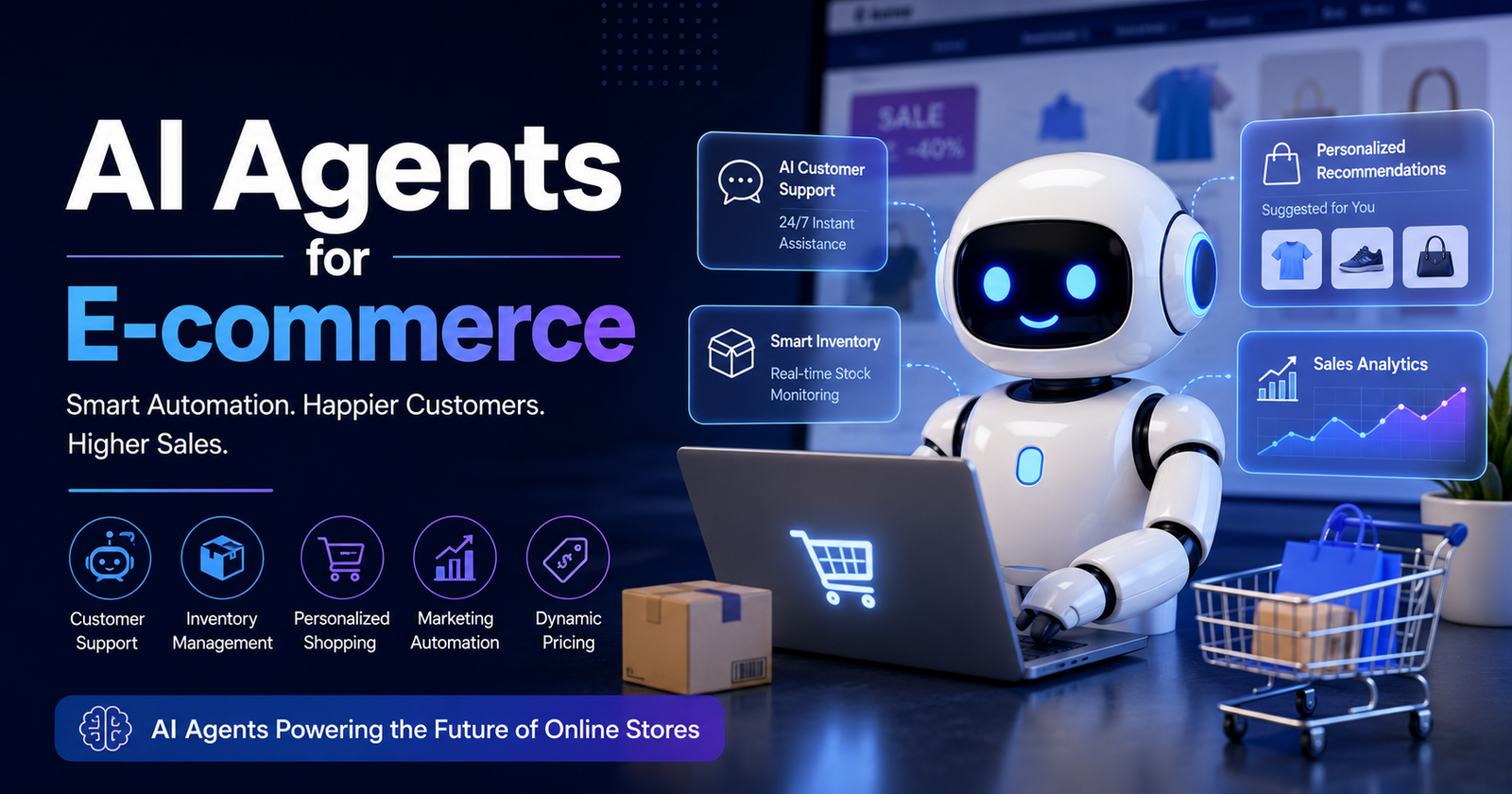
The e-commerce industry is changing quickly. Online stores now handle thousands of customer interactions, product updates, inventory checks, and marketing tasks every day. Managing all these activities manually takes time and often leads to mistakes. This is where AI Agents for E-commerce are making a huge difference.
AI agents are smart software systems that can understand information, make decisions, and complete tasks without constant human input. Unlike traditional automation tools that follow fixed rules, AI agents can analyze data, learn from patterns, and take actions based on changing situations. This makes them much more useful for modern online businesses.
Today, many online stores use AI agents to answer customer questions, manage inventory, optimize pricing, create product descriptions, and improve marketing campaigns. As AI technology continues to advance, AI agents are becoming an important part of successful e-commerce operations. Industry experts expect AI-powered shopping and commerce automation to grow significantly over the next few years.
This guide explains everything you need to know about AI Agents for E-commerce, including how they work, their benefits, real-world use cases, challenges, and future opportunities.
What Are AI Agents for E-commerce?
AI Agents for E-commerce are intelligent software programs that perform tasks independently for online businesses. These agents use technologies such as artificial intelligence, machine learning, and natural language processing to understand data, make decisions, and execute actions.
Traditional automation tools only follow predefined instructions. For example, a standard automation may send an email when a customer places an order. An AI agent can do much more. It can analyze customer behavior, personalize recommendations, identify problems, and decide the best action to take.
These agents work across different parts of an online store. They can communicate with customers, manage products, monitor inventory levels, track orders, and even suggest marketing strategies. Because they can process large amounts of data quickly, they help businesses operate more efficiently.
Modern e-commerce platforms are increasingly adopting AI-powered systems to improve customer experiences and reduce manual work. Many businesses now view AI agents as virtual team members that handle repetitive tasks while human employees focus on strategy and growth.
The growing popularity of AI Agents for E-commerce shows how businesses are moving toward smarter and more automated operations.
How AI Agents for E-commerce Work
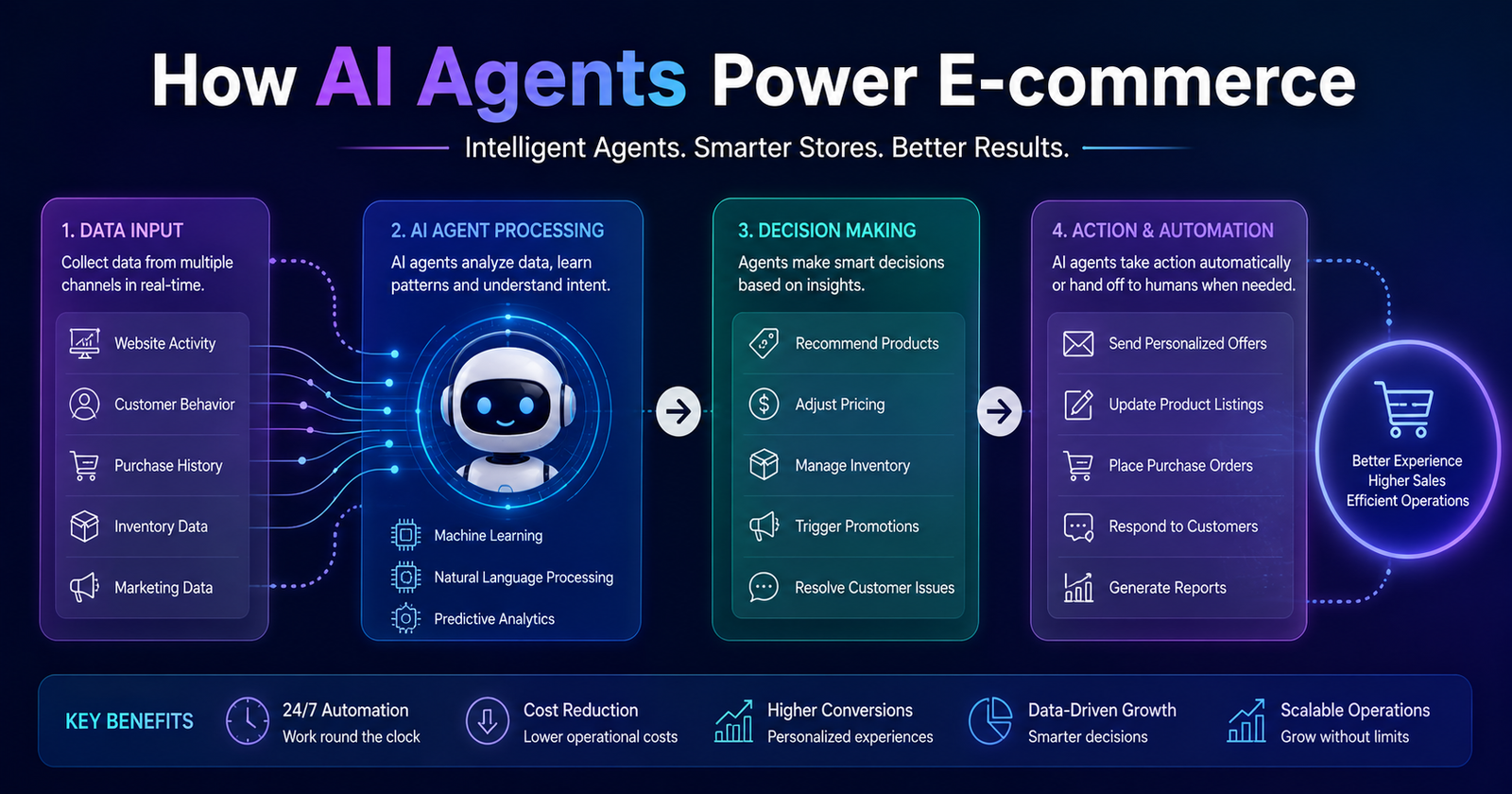
Understanding how AI Agents for E-commerce work helps businesses see their true value. These agents follow a process that combines data collection, analysis, decision-making, and action.
The first step involves gathering information from different sources. This may include customer behavior, purchase history, website activity, inventory records, and marketing data. The AI agent continuously monitors these sources to stay updated.
After collecting information, the agent analyzes patterns and identifies opportunities. For example, it may notice that a product is selling faster than expected or detect a rise in customer inquiries about shipping.
The next stage is decision-making. Using artificial intelligence models, the agent determines the best action based on available data. It may recommend restocking products, adjusting prices, or sending personalized offers to customers.
Finally, the agent performs the task automatically or presents recommendations to business owners. This process happens continuously, allowing online stores to respond quickly to changing conditions.
The ability to make decisions and execute actions with minimal human involvement is what makes AI agents different from traditional software tools. This capability is driving increased adoption across the e-commerce industry.
Benefits of AI Agents for E-commerce
The adoption of AI Agents for E-commerce provides several important benefits for online businesses. One of the biggest advantages is improved efficiency. AI agents can handle repetitive tasks much faster than humans, allowing teams to focus on strategic work.
Another major benefit is better customer service. AI agents can answer questions, provide product recommendations, and resolve common issues around the clock. Customers receive quick responses without waiting for human support.
AI agents also help reduce operational costs. Businesses can automate routine activities such as order tracking, inventory management, and customer communication. This reduces the need for extensive manual effort while maintaining service quality.
Personalization is another valuable advantage. AI agents analyze customer preferences and behavior to create tailored shopping experiences. Personalized recommendations often lead to higher conversion rates and increased sales.
Data-driven decision-making is also improved. AI agents process large amounts of information and identify trends that humans may overlook. This helps businesses make smarter decisions regarding pricing, promotions, and inventory planning.
The combination of automation, accuracy, and personalization makes AI Agents for E-commerce a powerful tool for online growth. Many retailers report significant improvements in productivity and customer satisfaction after implementing AI-driven solutions.
Customer Support with AI Agents for E-commerce
Customer support is one of the most popular applications of AI Agents for E-commerce. Online stores receive a large number of customer questions every day. Handling these inquiries manually can become overwhelming as businesses grow.
AI support agents can answer common questions instantly. They help customers check order status, understand shipping policies, request returns, and find product information. Because these agents operate 24/7, customers receive assistance whenever they need it.
Advanced AI agents understand natural language, allowing them to have more human-like conversations. They can recognize customer intent and provide relevant solutions without requiring exact keywords.
Many businesses use AI agents to handle routine inquiries while forwarding complex issues to human representatives. This approach improves efficiency without sacrificing service quality.
Research shows that AI-powered support systems can significantly reduce response times while improving customer satisfaction. These systems also help businesses lower support costs by automating a large percentage of repetitive inquiries.
As customer expectations continue to rise, AI Agents for E-commerce are becoming essential for delivering fast and reliable support.
Inventory Management Using AI Agents for E-commerce
Inventory management is a critical part of running a successful online store. Poor inventory planning can lead to stock shortages or excess inventory, both of which affect profitability.
AI Agents for E-commerce help solve these challenges by continuously monitoring inventory levels and sales trends. They analyze historical data, seasonal demand patterns, and customer behavior to forecast future inventory needs.
When inventory levels fall below a certain threshold, AI agents can automatically generate alerts or initiate restocking processes. This reduces the risk of stockouts and helps maintain product availability.
AI agents can also identify slow-moving products and recommend promotional strategies to improve sales. By analyzing demand patterns, they help businesses optimize inventory investments and reduce storage costs.
The ability to make accurate predictions gives businesses a competitive advantage. Instead of relying on manual calculations, companies can use AI-driven insights to improve inventory efficiency and customer satisfaction.
As e-commerce operations become more complex, AI-powered inventory management is becoming an important component of modern retail strategies.
Marketing Automation with AI Agents for E-commerce
Marketing requires constant attention to customer behavior, campaign performance, and market trends. AI Agents for E-commerce help automate many marketing activities while improving results.
AI agents can analyze customer data and create personalized marketing campaigns. They determine which products customers are most likely to purchase and deliver relevant recommendations through email, social media, or website content.
These agents also monitor campaign performance in real time. They identify successful strategies and suggest improvements for underperforming campaigns. This helps businesses maximize their marketing return on investment.
Content creation is another area where AI agents provide value. They can generate product descriptions, email content, promotional messages, and social media posts. This saves time while maintaining consistent communication.
Customer segmentation also becomes more effective with AI. Agents group customers based on behavior, interests, and purchasing history. This allows businesses to deliver highly targeted marketing messages.
By automating repetitive marketing tasks and improving personalization, AI Agents for E-commerce help businesses attract more customers and increase sales.
Common Use Cases of AI Agents for E-commerce
The following table highlights some of the most common applications of AI agents in online retail.
| Use Case | Purpose | Business Benefit |
|---|---|---|
| Customer Support | Answer customer inquiries | Faster responses |
| Product Recommendations | Suggest relevant products | Higher sales |
| Inventory Management | Monitor stock levels | Reduced shortages |
| Dynamic Pricing | Adjust prices automatically | Improved profitability |
| Order Tracking | Provide shipping updates | Better customer experience |
| Marketing Automation | Personalize campaigns | Increased conversions |
| Product Content Creation | Generate descriptions | Time savings |
| Review Management | Analyze customer feedback | Improved reputation |
These use cases demonstrate how AI Agents for E-commerce can support multiple business functions while improving efficiency and customer satisfaction.
Challenges of Implementing AI Agents for E-commerce
Although AI Agents for E-commerce offer many benefits, businesses should also understand potential challenges. One common issue involves data quality. AI agents depend on accurate data to make good decisions. Poor data can lead to incorrect recommendations and actions.
Integration can also be challenging. Businesses often use multiple systems for inventory, customer management, and marketing. Connecting AI agents to these platforms requires proper planning.
Another challenge involves customer trust. Some customers prefer interacting with human representatives, especially when dealing with complex issues. Businesses need to balance automation with human support.
Security and privacy concerns are also important. AI agents process customer information, making strong data protection measures essential.
Despite these challenges, most businesses find that the benefits outweigh the difficulties when implementation is done correctly. Experts recommend starting with smaller projects and gradually expanding AI capabilities as systems mature.
The Future of AI Agents for E-commerce
The future of AI Agents for E-commerce looks very promising. Industry experts predict that AI agents will become more autonomous and capable of handling increasingly complex tasks. AI-powered shopping assistants are already beginning to influence how customers discover and purchase products online.
Future AI agents may negotiate prices, compare products across multiple platforms, and complete purchases on behalf of customers. Businesses will need to optimize their stores not only for human shoppers but also for AI-driven shopping systems.
Advances in machine learning and natural language understanding will also improve customer interactions. AI agents will become more conversational, accurate, and personalized.
As adoption continues to grow, businesses that embrace AI technology early may gain a significant competitive advantage. The ability to automate operations, personalize experiences, and make data-driven decisions will become increasingly important in the evolving e-commerce landscape.
The rise of agentic commerce signals a major shift in how online retail operates. Companies that prepare today will be better positioned for future growth and innovation.
Conclusion
AI Agents for E-commerce are transforming the way online businesses operate. They automate repetitive tasks, improve customer service, optimize inventory management, and enhance marketing performance. By analyzing data and making intelligent decisions, these agents help businesses become more efficient and profitable.
As technology continues to advance, AI agents will play an even larger role in online retail. Businesses that adopt AI solutions can improve customer experiences, reduce costs, and stay competitive in a rapidly changing market.
Whether you run a small online store or a large e-commerce business, investing in AI agents can help you streamline operations and unlock new growth opportunities. The future of e-commerce is becoming increasingly intelligent, and AI agents are leading that transformation.
FAQs
What are AI Agents for E-commerce?
AI Agents for E-commerce are intelligent software systems that automate tasks such as customer support, inventory management, marketing, and order processing.
How do AI Agents for E-commerce improve customer service?
They provide instant responses, answer common questions, track orders, and offer personalized recommendations 24 hours a day.
Can AI Agents for E-commerce increase sales?
Yes. AI agents improve personalization, recommend products, optimize marketing campaigns, and help customers complete purchases more efficiently.
Are AI Agents for E-commerce suitable for small businesses?
Yes. Many affordable AI solutions are available for small online stores, helping them automate operations and compete more effectively.
What is the future of AI Agents for E-commerce?
AI agents are expected to become more autonomous, handle complex business tasks, and play a larger role in shopping experiences and online retail operations.