Introduction
Online shopping has changed a lot over the last few years. Customers no longer want to spend hours searching for the right product. They expect online stores to understand their needs and show the most suitable products. This is where AI Product Recommendations make a huge difference.
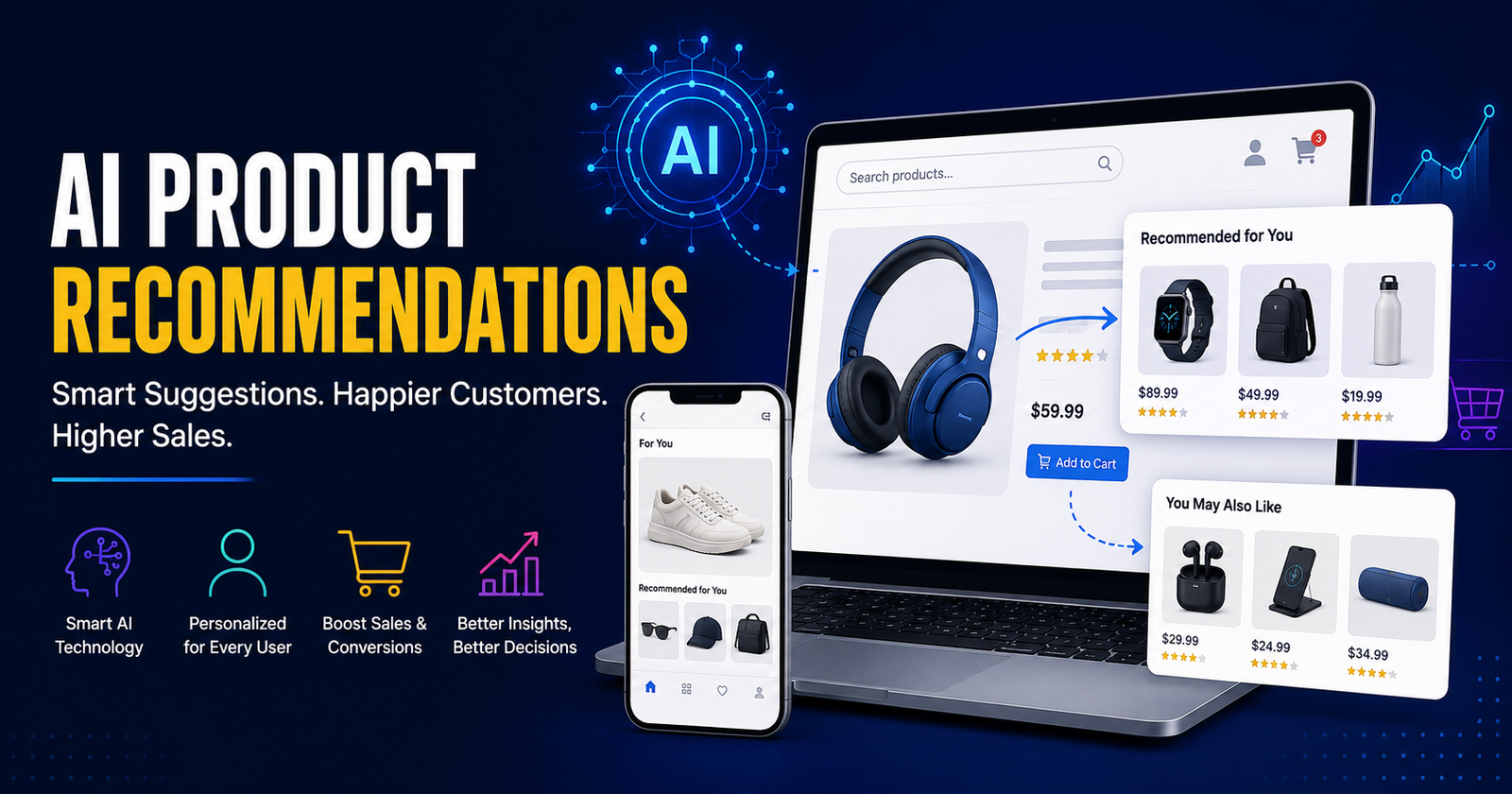
AI Product Recommendations use artificial intelligence to study customer behavior, shopping history, interests, and preferences. The system then suggests products that customers are more likely to buy. These suggestions appear on product pages, homepages, shopping carts, emails, and even advertisements.
Many of the world’s biggest eCommerce companies use AI Product Recommendations to improve customer experience and increase sales. Instead of showing random products, AI displays products that match each customer’s interests. This makes shopping faster, easier, and more enjoyable.
Today, AI recommendation technology is no longer limited to large companies. Small and medium-sized businesses can also use affordable AI tools to improve their online stores. Whether you sell clothing, electronics, beauty products, or digital goods, AI Product Recommendations can help you increase conversions and customer satisfaction.
This guide explains everything you need to know about AI Product Recommendations, how they work, their benefits, common types, and why they are becoming an essential part of every successful online business.
What Are AI Product Recommendations?
AI Product Recommendations are personalized product suggestions generated by artificial intelligence. Instead of showing the same products to every visitor, AI studies customer data and predicts which products each person is most interested in.
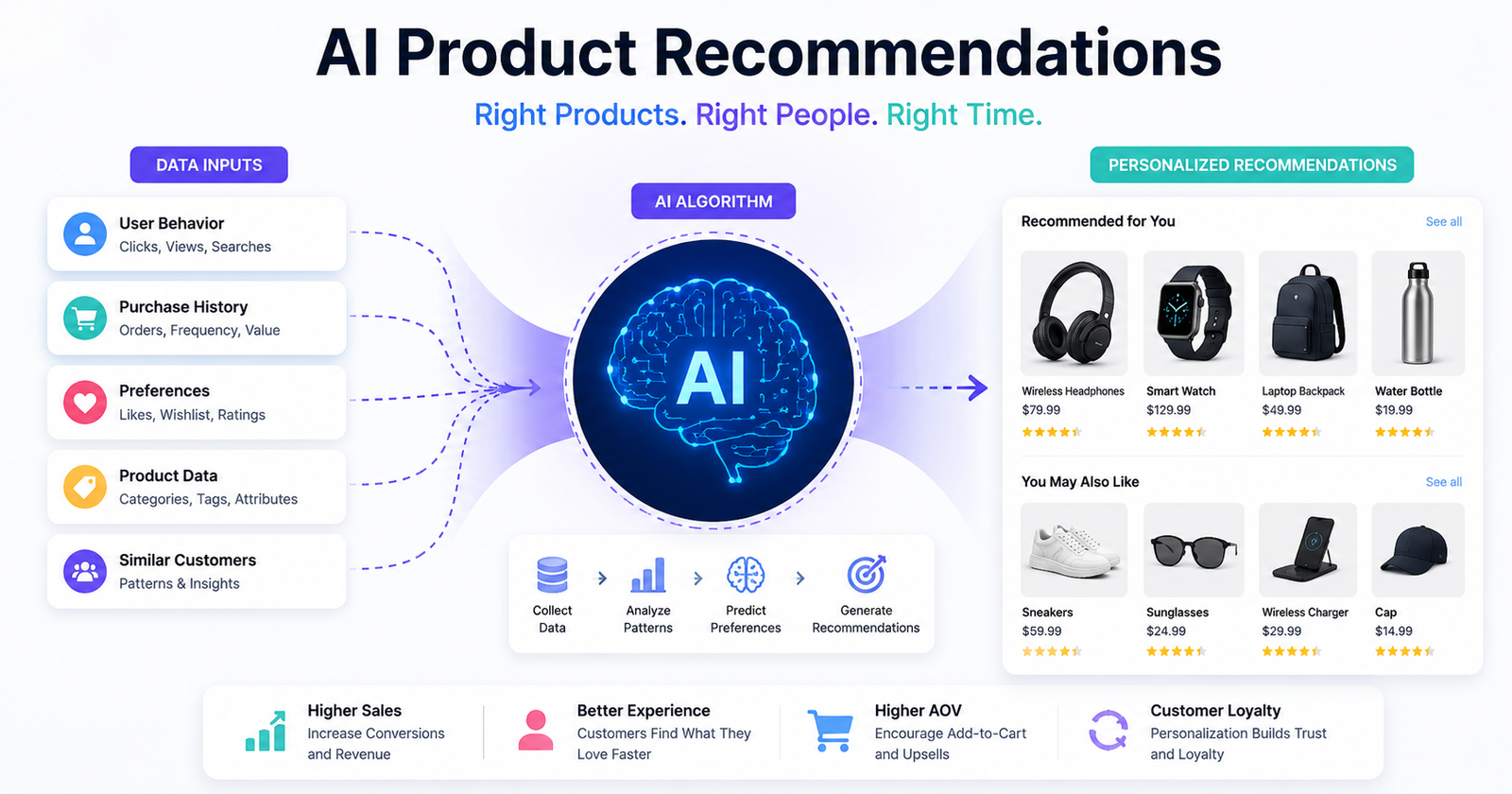
The recommendation system learns from different types of information. It looks at products customers viewed, items they added to their cart, previous purchases, search history, browsing time, product ratings, and similar customer behavior. The AI then combines all this information to recommend products with a high chance of being purchased.
Unlike traditional recommendation systems that depend on simple rules, AI Product Recommendations continue learning every day. As customers interact with the website, the AI becomes more accurate. This means recommendations improve over time without requiring constant manual updates.
For example, if a customer buys running shoes, the AI may recommend sports socks, fitness watches, or running shorts. If another customer frequently searches for gaming laptops, the system may suggest gaming accessories or high-performance monitors.
This personalized shopping experience helps customers discover products they genuinely need while helping businesses increase sales and customer loyalty.
Table: Traditional Recommendations vs AI Product Recommendations
| Feature | Traditional Recommendations | AI Product Recommendations |
|---|---|---|
| Personalization | Limited | Highly personalized |
| Learning Ability | Manual updates | Learns automatically |
| Customer Behavior Analysis | Basic | Advanced |
| Real-Time Suggestions | Rare | Yes |
| Accuracy | Moderate | High |
| Conversion Rate | Lower | Higher |
How AI Product Recommendations Work
Understanding how Product Recommendations work is easier than many people think. Behind every recommendation is a smart system that collects information, analyzes patterns, and predicts what customers may want next.
The first step involves collecting customer data. AI gathers information from website visits, search history, purchase history, product views, cart activity, and customer preferences. Every interaction helps the AI understand customer interests.
Next, machine learning algorithms analyze millions of data points. They compare customer behavior with similar shoppers. If many people who bought one product also purchased another, the AI learns this relationship.
Natural Language Processing also helps AI understand product descriptions, customer reviews, and search terms. Computer vision can even analyze product images to recommend visually similar products.
Finally, the recommendation engine generates personalized suggestions almost instantly. Every time the customer clicks, searches, or buys something, the AI updates its understanding and improves future recommendations.
This continuous learning process allows AI Recommendations to remain accurate even when customer preferences change.
Why AI Product Recommendations Matter in eCommerce
Modern customers expect online stores to offer a personalized shopping experience. Generic product listings no longer keep shoppers engaged. This is one of the biggest reasons why AI Product Recommendations have become so important.
When customers immediately see products that match their interests, they spend more time exploring the website. They discover products they may not have found through regular browsing. This increases engagement and improves the overall shopping experience.
Businesses also benefit because personalized recommendations encourage customers to purchase additional items. Many shoppers add recommended accessories or related products to their carts, increasing the average order value.
Another important advantage is customer retention. When shoppers consistently receive useful recommendations, they are more likely to return for future purchases. They begin to trust the store because it understands their needs.
Search costs also become lower. Instead of browsing hundreds of products, customers quickly find relevant options. This reduces frustration and improves customer satisfaction.
In today’s competitive market, businesses that use AI Product Recommendations often outperform stores that rely on manual product suggestions.
Benefits of AI Product Recommendations
There are many reasons why businesses are investing in AI Product Recommendations. The technology improves both customer experience and business performance at the same time.
One of the biggest advantages is higher conversion rates. Personalized recommendations show customers products they are already interested in, making purchases more likely.
Another major benefit is increased average order value. Customers often purchase complementary products that AI recommends during the shopping process.
Customer satisfaction also improves because shoppers save time. Instead of searching through hundreds of products, they quickly find relevant items that meet their needs.
Businesses also gain valuable insights into customer behavior. AI identifies shopping patterns that help companies improve inventory planning, marketing campaigns, and product placement.
Another important benefit is better customer loyalty. Personalized experiences encourage repeat purchases and stronger relationships with customers.
Table: Business Benefits of AI Product Recommendations
| Business Goal | How AI Product Recommendations Help |
|---|---|
| Increase Sales | Personalized product suggestions |
| Improve Customer Experience | Relevant shopping recommendations |
| Boost Average Order Value | Cross-selling and upselling |
| Increase Customer Loyalty | Better personalized experiences |
| Reduce Product Discovery Time | Faster product matching |
| Improve Marketing | More targeted campaigns |
Different Types of AI Product Recommendations
Not every recommendation works in the same way. Different types of AI Product Recommendations help customers at different stages of their shopping journey.
Related product recommendations appear on product pages. They suggest similar or complementary products that match the customer’s interests.
Frequently bought together recommendations encourage customers to purchase multiple items. This strategy works well for electronics, fashion, furniture, and beauty products.
Recently viewed recommendations remind customers about products they previously explored. These suggestions often increase return visits and completed purchases.
Personalized homepage recommendations display products based on previous shopping behavior. Every customer sees different products when visiting the website.
Trending product recommendations show popular products that many customers are currently purchasing. These recommendations help customers discover new products.
Seasonal recommendations change according to holidays, weather, or shopping trends. During winter, AI may recommend jackets, heaters, or winter accessories. During summer, it may suggest sunglasses, outdoor furniture, or cooling devices.
Each recommendation type serves a different purpose, but together they create a personalized shopping experience that benefits both customers and businesses.
AI Product Recommendation Algorithms
The success of AI Product Recommendations depends on powerful algorithms that analyze customer behavior and product information. These algorithms help online stores deliver personalized suggestions that match each shopper’s interests.
One common method is collaborative filtering. This algorithm compares customers with similar shopping habits. If two customers buy many of the same products, the system assumes they may like similar items in the future. This method works well for stores with a large number of customers and products.
Another popular method is content-based filtering. Instead of comparing customers, it studies the features of products. If someone buys a leather wallet, the AI may recommend other leather accessories with similar styles or materials.
Many modern eCommerce platforms use a hybrid recommendation system. This combines different algorithms to improve accuracy. The AI learns from customer behavior, product details, shopping trends, and purchase history at the same time.
Deep learning models have also improved AI Product Recommendations. These advanced models understand complex shopping patterns and deliver more accurate suggestions. As more customer data becomes available, the recommendations become even better.
By using these algorithms together, businesses can create a shopping experience that feels personal and relevant for every visitor.
AI Product Recommendations vs Traditional Recommendation Systems
Many businesses still use manual recommendation systems. However, these systems cannot compete with modern AI Product Recommendations.
Traditional systems often rely on fixed rules. For example, a store owner may manually link a phone with a phone case or a laptop with a laptop bag. While this works for basic recommendations, it cannot adapt to changing customer preferences.
AI Product Recommendations work differently. The system automatically studies customer activity and updates recommendations in real time. It understands which products customers view, purchase, ignore, or compare.
Another major difference is personalization. Traditional recommendations usually display the same products to everyone. AI shows different recommendations to different visitors based on their interests and shopping behavior.
AI also reacts much faster to market changes. If a product suddenly becomes popular, the recommendation engine quickly begins suggesting it to the right audience. Manual systems require someone to make those updates.
Table: AI Product Recommendations vs Traditional Systems
| Feature | Traditional System | AI Product Recommendations |
|---|---|---|
| Personalization | Low | Very High |
| Learning Ability | Manual | Automatic |
| Real-Time Updates | No | Yes |
| Customer Analysis | Limited | Advanced |
| Scalability | Moderate | Excellent |
| Recommendation Accuracy | Basic | High |
As online stores continue to grow, AI Product Recommendations provide a smarter and more flexible solution than manual recommendation methods.
Industries Using AI Product Recommendations
Although AI Product Recommendations are most common in eCommerce, many other industries now use this technology to improve customer experience.
Fashion stores use AI to recommend clothing, shoes, and accessories that match previous purchases or browsing history. Beauty brands suggest skincare and makeup products based on customer preferences.
Electronics retailers recommend compatible accessories, extended warranties, and related gadgets. Grocery stores personalize food suggestions according to buying habits and seasonal trends.
Streaming platforms recommend movies, TV shows, music, and podcasts based on viewing or listening history. Online learning platforms suggest courses that match a student’s interests and learning progress.
Healthcare companies use recommendation systems to guide customers toward wellness products or health-related services. Travel websites recommend hotels, flights, and vacation packages based on previous bookings and searches.
Financial service providers also benefit from AI Product Recommendations. They suggest suitable banking products, insurance plans, or investment options based on customer needs.
This wide range of applications shows that recommendation technology is becoming valuable in almost every industry where customers make choices.
Best AI Product Recommendation Tools in 2026
Businesses have many options when choosing software for AI Product Recommendations. The right tool depends on business size, budget, and platform.
Shopify users often choose built-in AI apps that integrate directly with their stores. These apps automatically recommend products without requiring advanced technical knowledge.
WooCommerce store owners can install AI-powered recommendation plugins that analyze customer behavior and generate personalized suggestions.
Large businesses frequently use enterprise platforms that offer advanced machine learning, customer segmentation, and predictive analytics. These platforms process large amounts of customer data and support thousands of daily visitors.
Some AI tools also integrate with email marketing platforms. They personalize product recommendations inside marketing emails, increasing click-through rates and sales.
Table: Popular AI Product Recommendation Tools
| Tool | Best For | Main Feature |
|---|---|---|
| Shopify AI Apps | Shopify Stores | Personalized product suggestions |
| WooCommerce AI Plugins | WordPress Stores | Smart recommendations |
| Dynamic Yield | Large Businesses | Personalization platform |
| Nosto | Fashion & Retail | AI merchandising |
| Bloomreach | Enterprise eCommerce | Customer personalization |
| Algolia Recommend | Large Product Catalogs | Fast AI recommendations |
Businesses should choose a tool that matches their current needs while allowing room for future growth.
Challenges of AI Product Recommendations
While AI Product Recommendations offer many benefits, businesses should also understand the challenges.
One challenge is data quality. AI performs best when it has enough customer data. New online stores with limited traffic may need more time before recommendations become highly accurate.
Privacy is another important concern. Businesses must collect customer information responsibly and follow local privacy laws. Customers should understand how their data is used.
Implementation can also require technical knowledge. Some advanced AI systems need integration with eCommerce platforms, customer databases, and analytics tools.
Another challenge is maintaining customer trust. If recommendations become too repetitive or irrelevant, shoppers may ignore them. Businesses should regularly review recommendation performance and improve the customer experience.
Finally, AI systems require continuous monitoring. Consumer preferences change throughout the year, and recommendation models must adapt to these changes.
Despite these challenges, the long-term benefits of AI Product Recommendations usually outweigh the initial effort.
Best Practices for AI Product Recommendations
Businesses can achieve better results by following a few proven practices when using AI Product Recommendations.
The recommendation engine should receive accurate and updated product information. Clear product titles, descriptions, categories, and images help the AI understand each product.
Customer behavior should also be tracked carefully. Browsing history, purchases, searches, and cart activity provide valuable information for better recommendations.
Testing different recommendation locations is also important. Some stores achieve better results by placing recommendations on product pages, while others see higher conversions in shopping carts or email campaigns.
Businesses should regularly review recommendation performance. Measuring click rates, conversion rates, and average order value helps identify areas for improvement.
Most importantly, recommendations should always provide value to customers. Showing relevant products creates trust and encourages repeat purchases.
Following these practices helps businesses maximize the benefits of AI Product Recommendations while creating a better shopping experience.
The Future of AI Product Recommendations
The future of AI Product Recommendations looks very promising. Artificial intelligence continues to improve every year, making recommendations more accurate and personalized.
Generative AI is beginning to transform online shopping. Instead of simply suggesting products, AI can explain why a product matches a customer’s needs and answer shopping questions in natural language.
Voice assistants will also become more involved in personalized shopping. Customers will receive product recommendations through voice conversations while browsing online stores.
Visual search technology is expected to grow rapidly. Customers will upload a photo, and AI will recommend visually similar products within seconds.
Real-time personalization will continue improving as AI processes customer behavior instantly. Every click, search, and purchase will help generate even better recommendations during the same shopping session.
Predictive AI will also become more advanced. Instead of reacting to customer behavior, future AI Product Recommendations will predict customer needs before shoppers begin searching.
As artificial intelligence evolves, personalized shopping will become the standard experience for customers around the world.
Conclusion
AI Product Recommendations have become one of the most valuable technologies in modern eCommerce. They help businesses understand customer preferences, deliver personalized shopping experiences, and increase sales without relying on manual product suggestions.
From improving conversion rates to boosting customer loyalty, AI Product Recommendations provide benefits for businesses of every size. Whether you operate a small online store or a large retail website, AI can help customers discover products more easily and enjoy a smoother shopping journey.
As technology continues to advance, recommendation systems will become even smarter. Businesses that invest in AI Product Recommendations today will be better prepared for the future of online shopping and will have a stronger competitive advantage in an increasingly digital marketplace.
Frequently Asked Questions
What are AI Product Recommendations?
AI Product Recommendations are personalized product suggestions created using artificial intelligence. They analyze customer behavior, browsing history, and purchase patterns to recommend products that customers are more likely to buy.
How do AI Product Recommendations increase sales?
AI Product Recommendations increase sales by showing customers relevant products based on their interests. Personalized suggestions encourage additional purchases, improve conversion rates, and increase average order value.
Are AI Product Recommendations suitable for small businesses?
Yes. Many affordable AI tools are available for Shopify, WooCommerce, and other eCommerce platforms. Small businesses can use AI Product Recommendations to improve customer experience and compete with larger retailers.
Which industries use AI Product Recommendations?
Many industries use AI Product Recommendations, including eCommerce, fashion, beauty, electronics, healthcare, travel, online education, streaming services, and financial services.
What is the future of AI Product Recommendations?
The future of AI Product Recommendations includes generative AI, voice shopping, visual search, predictive analytics, and real-time personalization. These technologies will make online shopping faster, smarter, and more personalized for every customer.