Introduction
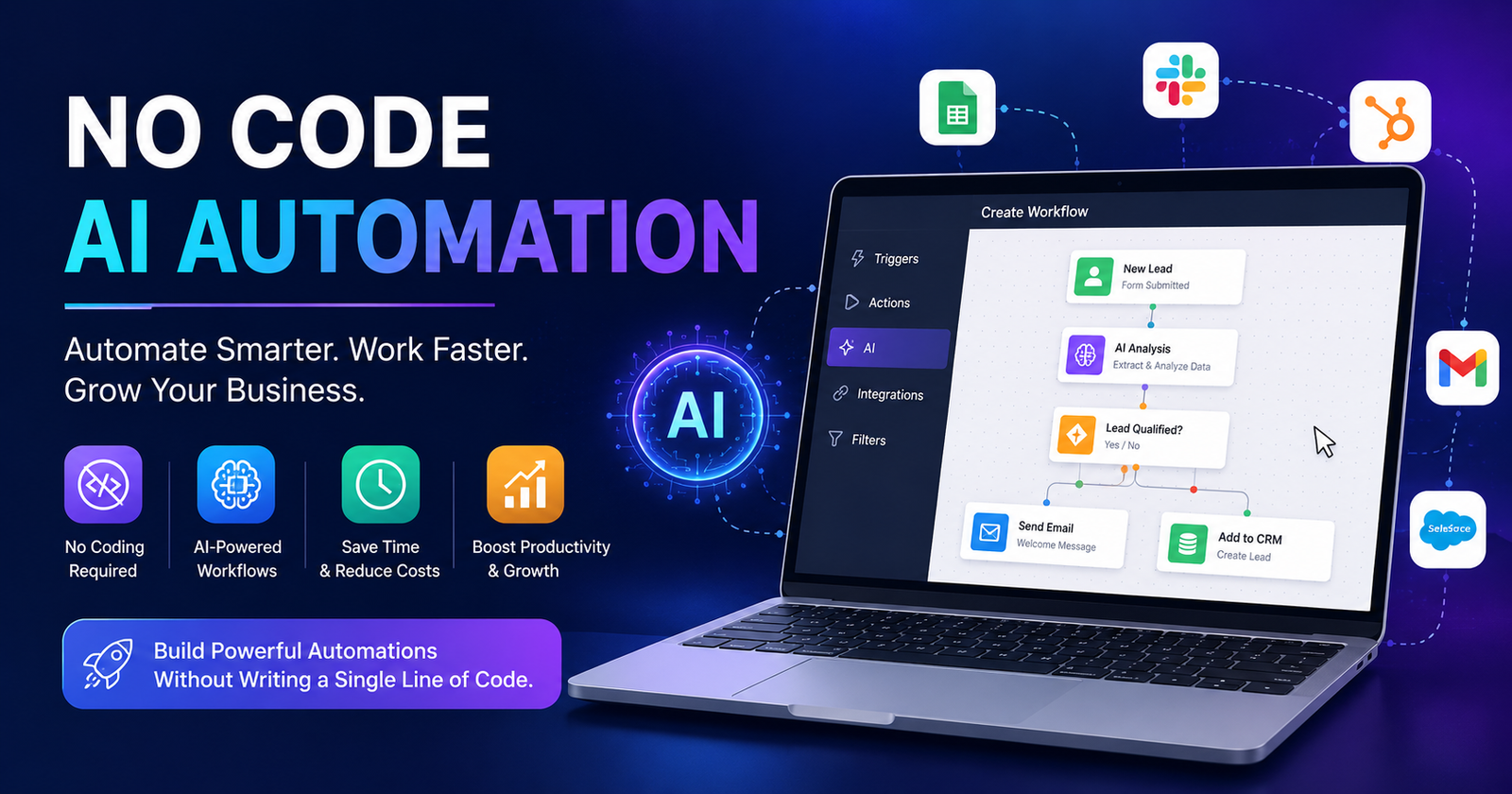
No code AI automation is changing the way businesses work. In the past, companies needed developers and technical teams to automate tasks. Today, anyone can build smart workflows with simple drag-and-drop tools and artificial intelligence.
Businesses use no code AI automation to handle repetitive work, improve customer service, manage leads, create content, process data, and connect different apps. These tools help companies save time and reduce manual effort.
The rise of artificial intelligence has made automation even more powerful. Modern platforms can understand text, generate content, analyze data, and make decisions based on user instructions. This means businesses can automate complex tasks without writing a single line of code. Recent industry reports show that no-code and low-code platforms continue to grow rapidly as organizations look for faster ways to build applications and automate workflows.
Whether you run a small business, an online store, or a large company, no code AI automation can help improve productivity and reduce costs. This guide explains everything you need to know about no code AI automation, its benefits, use cases, tools, challenges, and future trends.
What Is No Code AI Automation?
No code AI automation refers to the use of visual software platforms that allow users to create automated workflows powered by artificial intelligence without programming knowledge.
Instead of writing code, users build workflows using visual builders, templates, forms, and drag-and-drop elements. AI handles tasks such as text generation, data analysis, customer interactions, and decision-making.
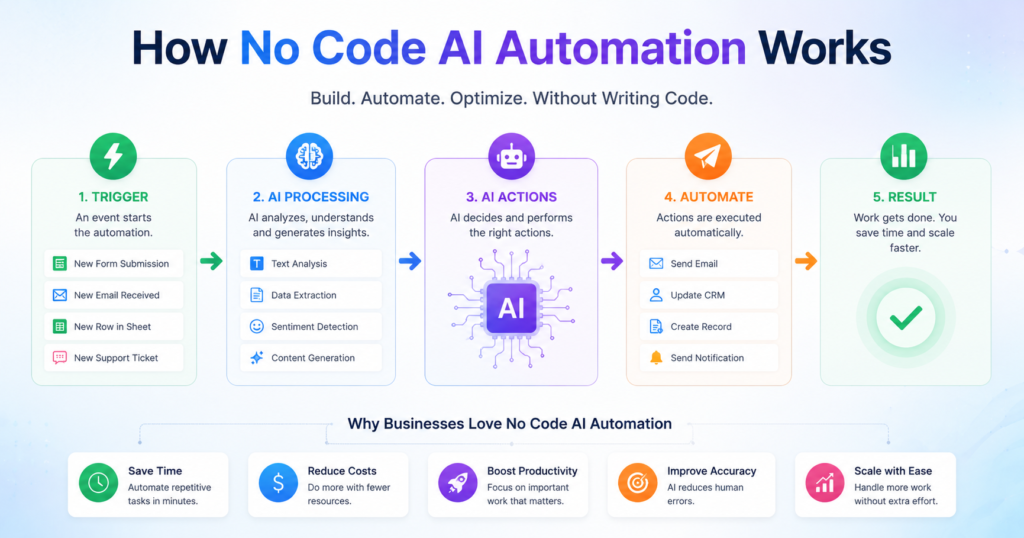
A typical no code AI automation workflow starts with a trigger. The trigger could be a new email, form submission, customer message, or uploaded document. The platform then processes the information using AI and performs the required actions automatically.
For example, when a customer fills out a contact form, AI can analyze the inquiry, classify it, send an instant response, create a CRM record, and notify the sales team.
The biggest advantage is accessibility. People without technical backgrounds can create advanced automation workflows. This allows marketing teams, HR departments, customer support teams, and business owners to automate work without depending on developers. Modern no-code platforms combine visual workflow builders with AI capabilities, making automation available to a much wider audience.
How No Code AI Automation Works
Understanding how no code AI automation works is easier than many people think. Most platforms follow a simple workflow structure.
The first step is selecting a trigger. A trigger starts the automation process. Examples include receiving an email, submitting a form, adding a new customer, or uploading a file.
The second step is processing data. Artificial intelligence analyzes the information. It may summarize text, extract important details, classify requests, or generate responses.
The final step is performing actions. These actions may include sending emails, updating records, creating reports, posting content, or notifying team members.
The process happens automatically in real time. Once the workflow is active, it continues working without manual effort.
| Component | Purpose |
|---|---|
| Trigger | Starts the automation |
| AI Processing | Analyzes or generates information |
| Action | Performs a task automatically |
| Integration | Connects multiple applications |
| Monitoring | Tracks workflow performance |
This structure allows businesses to automate hundreds of daily tasks while maintaining accuracy and speed.
Benefits of No Code AI Automation
The popularity of no code AI automation continues to grow because it provides significant business benefits.
One major advantage is faster implementation. Traditional software development projects often take months. No-code platforms allow businesses to build automation in hours or days. Organizations increasingly use these tools to speed up development and workflow creation.
Cost savings are another important benefit. Businesses do not need large development teams for many automation projects. Teams can create workflows independently and reduce operational expenses.
Productivity also improves significantly. Employees spend less time on repetitive work and more time on strategic activities. Tasks such as data entry, reporting, scheduling, and document processing can run automatically.
No code AI automation also improves consistency. Human errors decrease because workflows follow predefined rules. This results in more accurate data and smoother business operations.
Scalability is another advantage. As businesses grow, automation can handle increasing workloads without requiring additional staff. This allows companies to expand efficiently while maintaining service quality.
Popular Use Cases for No Code AI Automation
Businesses across many industries use no code AI automation to solve daily challenges and improve efficiency.
Customer support is one of the most common applications. AI chatbots answer questions, route requests, and provide support around the clock. New AI business agents are increasingly being used to qualify leads, answer customer inquiries, and automate routine business operations.
Marketing teams use automation to generate content, schedule campaigns, manage leads, and personalize customer communication.
Human resources departments automate employee onboarding, document collection, interview scheduling, and training processes.
Sales teams use AI to score leads, update CRM systems, send follow-up emails, and track customer interactions.
Finance departments automate invoice processing, expense approvals, and financial reporting.
E-commerce businesses use no code AI automation for order management, customer support, inventory updates, and personalized recommendations.
| Industry | Common Automation Tasks |
| Marketing | Lead nurturing and content creation |
| Sales | Lead scoring and follow-up emails |
| HR | Employee onboarding |
| Finance | Invoice processing |
| E-commerce | Order and customer management |
| Customer Support | AI chat assistance |
These use cases demonstrate how flexible no code AI automation has become.
Best No Code AI Automation Tools
Many platforms now offer powerful no code AI automation features. Each platform serves different business needs.
Zapier is one of the most popular automation tools. It connects thousands of applications and allows users to build workflows without coding.
Make offers advanced visual workflow design. Businesses use it for complex automation processes involving multiple applications.
n8n has become increasingly popular because it offers flexibility and supports advanced AI workflows. Industry reports highlight strong growth in AI-enabled workflow automation platforms such as Zapier, Make, and n8n.
Bubble helps users build complete web applications without coding.
Glide allows businesses to create mobile apps using spreadsheets and visual interfaces.
Flowise and similar AI-focused tools help users build AI applications and chatbot workflows without programming.
Choosing the right platform depends on business goals, required integrations, budget, and workflow complexity.
How Businesses Can Start With No Code AI Automation
Starting with no code AI automation does not require a large investment or technical expertise. Businesses can begin with small projects and expand over time.
The first step is identifying repetitive tasks. Look for activities that consume time but follow predictable processes. These tasks are ideal candidates for automation.
The next step is selecting the right platform. Businesses should evaluate available integrations, AI capabilities, pricing, and ease of use.
After choosing a platform, create a simple workflow. Start with one process, such as lead management or email automation. Test the workflow carefully before deploying it fully.
Monitoring performance is also important. Track results, identify bottlenecks, and optimize workflows as business needs change.
Successful companies often begin with small automation projects. Once they see positive results, they expand automation into other departments.
This gradual approach reduces risk and allows teams to gain confidence with the technology.
Challenges of No Code AI Automation
Although no code AI automation offers many advantages, businesses should understand its limitations.
Complex workflows sometimes require technical knowledge. While platforms reduce coding requirements, users still need to understand workflow logic, integrations, and business processes. Many users report that concepts such as webhooks, data mapping, and workflow design remain important even in no-code environments.
Scalability can also become a challenge for highly customized applications. Some businesses eventually require low-code or custom development solutions.
Vendor dependency is another concern. Organizations that rely heavily on a single platform may face limitations if pricing or features change. Industry discussions continue to highlight the importance of avoiding vendor lock-in when building long-term automation systems.
Security and compliance requirements must also be considered. Businesses should verify that automation platforms meet industry standards and data protection requirements.
Despite these challenges, most organizations find that the benefits of no code AI automation outweigh the limitations.
Future of No Code AI Automation
The future of no code AI automation looks extremely promising. Artificial intelligence continues to improve rapidly, making automation smarter and more accessible.
Many platforms now allow users to create applications using simple natural language prompts. Instead of designing workflows manually, users can describe what they want, and AI builds the solution automatically. Industry analysts expect AI-generated applications and autonomous workflow agents to become major drivers of future no-code adoption.
AI agents are also becoming more capable. These agents can perform multi-step tasks, make decisions, and interact with various software systems independently.
Businesses are increasingly adopting AI-powered workflow automation to improve efficiency and competitiveness. Market research indicates strong growth in no-code AI platforms and widespread adoption across organizations.
As technology advances, the line between software development and automation will continue to blur. More people will be able to create sophisticated applications without programming skills.
The future will likely bring smarter automation, deeper integrations, improved security, and greater business value.
Conclusion
No code AI automation is transforming the way businesses operate. It allows organizations to automate repetitive tasks, improve productivity, reduce costs, and accelerate growth without requiring programming expertise.
From customer support and marketing to sales and finance, no code AI automation offers practical solutions for almost every department. Modern platforms make it possible to build powerful workflows using simple visual tools and artificial intelligence.
While challenges such as scalability and platform dependency exist, the advantages remain significant. Businesses that embrace no code AI automation can work faster, respond more effectively to customer needs, and remain competitive in a rapidly changing market.
As AI technology continues to evolve, no code AI automation will become even more powerful and accessible. Companies that start exploring automation today will be better prepared for the future of digital business.
FAQs
Is no code AI automation suitable for small businesses?
Yes. Small businesses can benefit greatly from no code AI automation because it reduces costs, saves time, and improves efficiency without requiring developers.
Do I need programming skills for no code AI automation?
No. Most no-code platforms use visual builders and drag-and-drop interfaces that allow non-technical users to create workflows.
Which industries use no code AI automation?
Many industries use it, including marketing, sales, healthcare, finance, education, customer support, and e-commerce.
Can no code AI automation replace employees?
No. It mainly handles repetitive tasks and allows employees to focus on higher-value work that requires creativity and decision-making.
What is the best no code AI automation platform?
The best platform depends on your needs. Popular choices include Zapier, Make, n8n, Bubble, Glide, and Flowise.