

Introduction
Businesses today want to save time and improve productivity. They also want to reduce repetitive work. This is where Claude for automation becomes useful. Claude is a powerful AI assistant that can handle many business tasks automatically. It can write content, summarize information, answer questions, organize data, and help teams work faster.
Many companies now use AI tools to automate daily processes. Claude stands out because it understands context well and creates natural responses. It can work with large amounts of information and help employees complete tasks in less time.
Whether you run a small business or a large company, Claude can support many automation workflows. It helps reduce manual effort and allows teams to focus on important work. From customer support to content creation, Claude can improve efficiency across departments.
This guide explains how Claude for automation works, its benefits, practical use cases, and the best ways to implement it in your business.
What Is Claude for Automation?
Claude for automation refers to using Claude AI to perform tasks automatically with minimal human involvement. Instead of spending hours on repetitive activities, businesses can use Claude to complete many of these tasks quickly and accurately.
Claude uses advanced language understanding to process information and generate useful outputs. It can read documents, analyze text, answer questions, and create content based on instructions. This makes it suitable for many automation workflows.
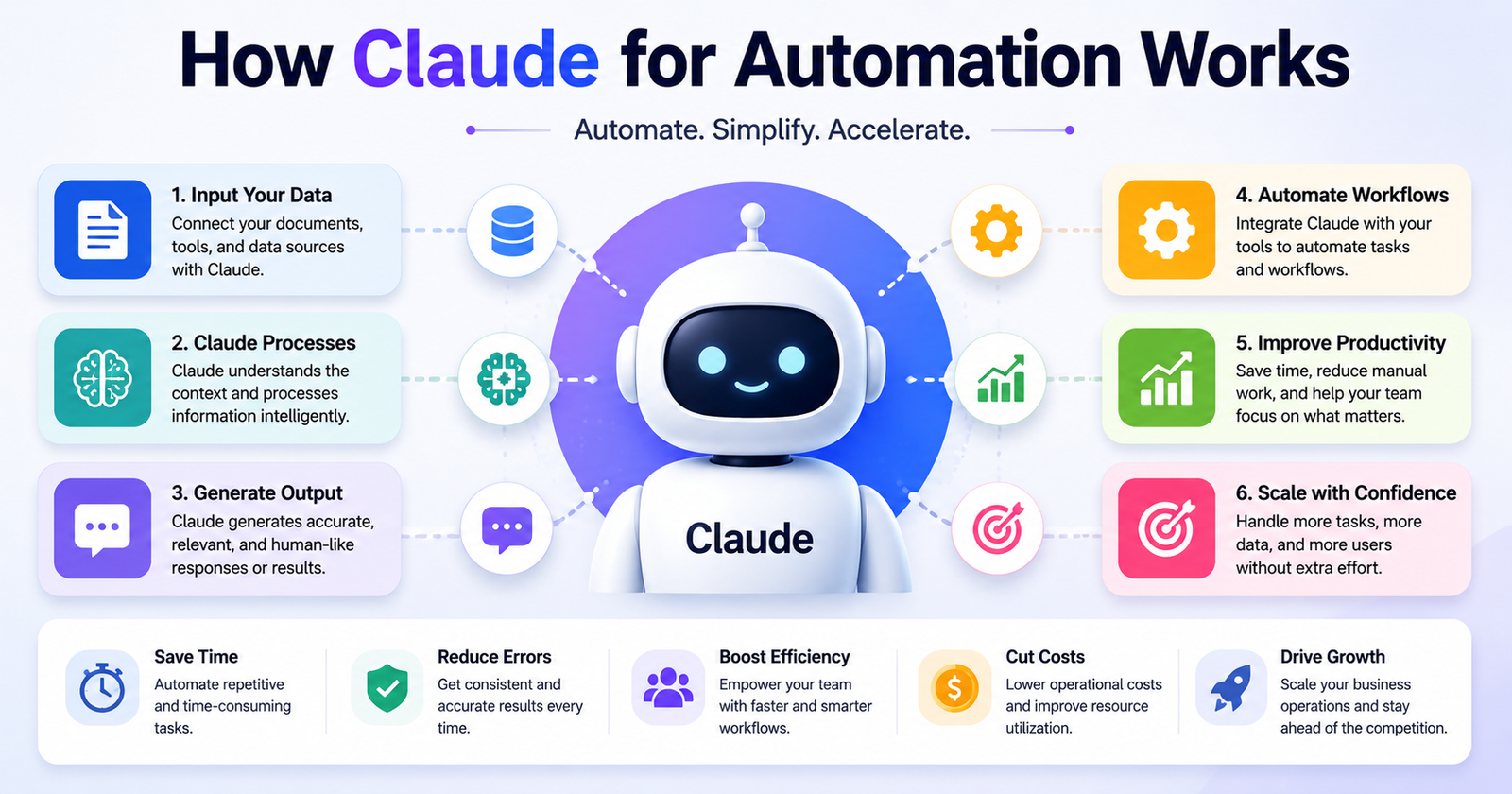
Businesses often connect Claude with other software tools through APIs and automation platforms. Once connected, Claude can receive information, process it, and generate responses automatically. This creates a smooth workflow that saves both time and effort.
Unlike traditional automation systems that follow fixed rules, Claude can understand context and adapt to different situations. This flexibility allows businesses to automate more complex tasks.
As organizations continue to adopt AI technology, Claude for automation is becoming a valuable solution for improving productivity and reducing operational costs.
Why Businesses Are Using Claude for Automation
Companies face increasing pressure to do more work without increasing costs. Automation helps solve this challenge. Claude provides businesses with an easy way to automate tasks that normally require human attention.
One major reason businesses choose Claude is its ability to understand natural language. Employees can provide simple instructions, and Claude can perform the requested task. This reduces the need for complicated programming knowledge.
Another advantage is speed. Claude can process information in seconds. Tasks that may take employees several hours can often be completed much faster. This improves overall efficiency and allows teams to focus on strategic work.
Businesses also value consistency. Human errors can happen when employees repeat the same task many times. Claude helps maintain a consistent standard across automated processes.
The growing popularity of Claude for automation also comes from its flexibility. Companies can use it in marketing, customer service, operations, research, and many other departments. This broad range of applications makes Claude a valuable investment for organizations of all sizes.
Key Benefits of Claude for Automation
Using Claude for automation offers several benefits that directly impact business performance. These benefits go beyond simple time savings and can improve overall operational efficiency.
| Benefit | Impact on Business |
|---|---|
| Time Savings | Reduces repetitive manual work |
| Higher Productivity | Allows teams to focus on important tasks |
| Better Accuracy | Minimizes human errors |
| Cost Reduction | Lowers operational expenses |
| Scalability | Handles increasing workloads easily |
| Consistency | Maintains quality across tasks |
One of the most important advantages is improved productivity. Employees spend less time on routine work and more time on creative and strategic activities.
Another benefit is scalability. As businesses grow, workloads increase. Claude can handle large volumes of tasks without requiring additional staff. This helps companies grow efficiently.
The ability to automate knowledge-based work is another major advantage. Claude can analyze information, generate summaries, and provide recommendations. These capabilities make Claude for automation valuable across many industries.
Claude for Automation in Content Creation
Content creation is one of the most popular uses of Claude for automation. Marketing teams often spend significant time creating blog posts, social media updates, product descriptions, and email campaigns.
Claude can help automate much of this work. It can generate content ideas, create drafts, and rewrite existing text. This allows marketers to produce more content in less time.
Businesses also use Claude to maintain a consistent brand voice. By providing clear instructions, teams can ensure that generated content follows company guidelines.
Another advantage is faster content production. Marketing departments often work under tight deadlines. Claude helps speed up the content creation process while maintaining quality.
Many organizations use Claude to create first drafts that employees later review and refine. This approach combines AI efficiency with human creativity. As a result, businesses can scale their content efforts without significantly increasing costs.
The growing demand for digital marketing makes Claude for automation an essential tool for content teams looking to improve productivity.
Claude for Automation in Customer Support
Customer support teams often deal with repetitive questions and requests. This creates a perfect opportunity for automation. Claude can help businesses improve customer service while reducing workload.
Many organizations use Claude to create automated support systems. These systems can answer common customer questions, provide information, and guide users through basic processes.
When customers need assistance, Claude can quickly analyze their questions and generate relevant responses. This reduces waiting times and improves customer satisfaction.
Support teams can also use Claude to summarize customer conversations. This helps agents understand issues faster and provide better assistance.
Another advantage is availability. Automated systems powered by Claude can operate around the clock. Customers can receive help even outside regular business hours.
As customer expectations continue to rise, Claude for automation provides businesses with a practical way to deliver fast and efficient support without increasing staffing costs.
Claude for Automation in Data Analysis and Research
Businesses generate large amounts of information every day. Analyzing this data manually can be time-consuming and expensive. Claude helps automate many research and analysis tasks.
Teams can use Claude to review reports, summarize findings, and identify important information. This allows decision-makers to access insights quickly.
Researchers also benefit from automation. Claude can process lengthy documents and create concise summaries. This saves time and helps teams focus on interpretation rather than data collection.
Another useful application involves market research. Businesses can gather information from multiple sources and use Claude to organize findings into clear reports.
The ability to analyze large volumes of text makes Claude for automation particularly useful for knowledge-based industries. Companies can gain valuable insights faster and improve decision-making processes.
By reducing manual research work, Claude helps organizations become more efficient and responsive to changing market conditions.
How to Implement Claude for Automation Successfully
Successful implementation requires careful planning. Businesses should begin by identifying repetitive tasks that consume significant time and resources.
The next step involves defining clear goals. Companies should determine what they want to achieve through automation. Common objectives include reducing costs, improving productivity, and enhancing customer experiences.
Organizations should also evaluate existing workflows. Understanding current processes helps identify opportunities where Claude can provide the greatest value.
Training employees is another important factor. Teams need to understand how to use Claude effectively and how to review AI-generated outputs.
Businesses should start with small projects before expanding automation efforts. This approach allows teams to learn and make adjustments before implementing larger solutions.
Monitoring performance is equally important. Companies should track results and measure improvements over time. By following these best practices, organizations can maximize the benefits of Claude for automation and achieve long-term success.
Challenges of Using Claude for Automation
Although Claude for automation offers many benefits, businesses should also understand potential challenges. Proper planning helps minimize these issues and ensures successful adoption.
One challenge involves accuracy. While Claude performs well in many situations, businesses should review important outputs before using them in critical decisions.
Data privacy is another consideration. Organizations must ensure that sensitive information is handled according to company policies and regulations.
Employee adoption can also present challenges. Some team members may be unfamiliar with AI tools. Proper training and communication can help build confidence and encourage adoption.
Businesses should also avoid relying entirely on automation. Human oversight remains important for quality control and strategic decision-making.
Despite these challenges, most organizations find that the benefits outweigh the risks. With proper management and clear guidelines, Claude can become a valuable part of business operations.
The Future of Claude for Automation
The future of Claude for automation looks promising. AI technology continues to improve, and businesses are finding new ways to automate complex tasks.
Future developments may allow Claude to handle more advanced workflows and integrate with a wider range of business tools. This will create even greater opportunities for efficiency and productivity.
Organizations are also exploring AI-powered decision support systems. These systems can help leaders analyze information and make informed choices more quickly.
As automation technology evolves, businesses that adopt AI solutions early may gain a competitive advantage. They can reduce operational costs, improve customer experiences, and respond faster to market changes.
The increasing demand for productivity and efficiency will likely drive continued adoption of Claude across industries. Companies that invest in automation today may be better prepared for the future business landscape.
Conclusion
Claude for automation is transforming how businesses handle daily tasks. It helps organizations save time, reduce manual work, improve accuracy, and increase productivity. From content creation and customer support to research and data analysis, Claude offers practical solutions for many business challenges.
Companies of all sizes can benefit from integrating Claude into their workflows. The key is to start with clear goals, identify suitable tasks, and maintain proper oversight. When used effectively, Claude becomes a valuable tool that supports growth and efficiency.
As AI technology continues to evolve, the role of Claude for automation will become even more important. Businesses that embrace automation today can position themselves for greater success in the years ahead.
Frequently Asked Questions
Is Claude good for business automation?
Yes. Claude is highly effective for business automation. It can automate content creation, customer support, research, data analysis, and many other tasks.
Can Claude integrate with other tools?
Yes. Claude can connect with various software platforms and automation systems through APIs and integrations.
Is Claude for automation suitable for small businesses?
Yes. Small businesses can use Claude to reduce workload, improve productivity, and save operational costs without hiring additional staff.
What tasks can Claude automate?
Claude can automate writing, summarization, customer support responses, research, document analysis, workflow assistance, and many other business processes.
Does Claude for automation replace employees?
Claude helps employees work more efficiently rather than replacing them. It handles repetitive tasks so teams can focus on strategic and creative work.