
Marketing has changed a lot in recent years. Businesses no longer need to spend hours on repetitive tasks. Modern AI Marketing automation tools can handle email campaigns, customer follow-ups, lead nurturing, content creation, and data analysis with very little manual work.
These tools help businesses save time, reduce costs, and improve results. Whether you run a small business, an eCommerce store, or a large company, AI can make marketing more effective.
In this guide, you will learn what AI marketing automation tools are, how they work, their benefits, and the best tools available today. You will also discover how to choose the right solution for your business.
What Are AI Marketing Automation Tools?
AI marketing automation tools are software platforms that combine artificial intelligence with marketing automation. They help businesses automate marketing tasks while using AI to improve decisions and customer experiences.
Traditional automation follows fixed rules. AI automation goes further by learning from customer behavior and making smart recommendations. It can predict customer actions, personalize messages, and optimize campaigns automatically.
Businesses use these automation tools for email marketing, social media management, lead scoring, customer segmentation, content creation, and campaign optimization.
For example, instead of sending the same email to every customer, AI can analyze customer behavior and send personalized messages at the best time. This increases engagement and improves conversion rates.
As competition grows online, businesses need smarter ways to reach customers. AI tools help companies stay competitive while reducing manual work.
How AI Marketing Automation Tools Work
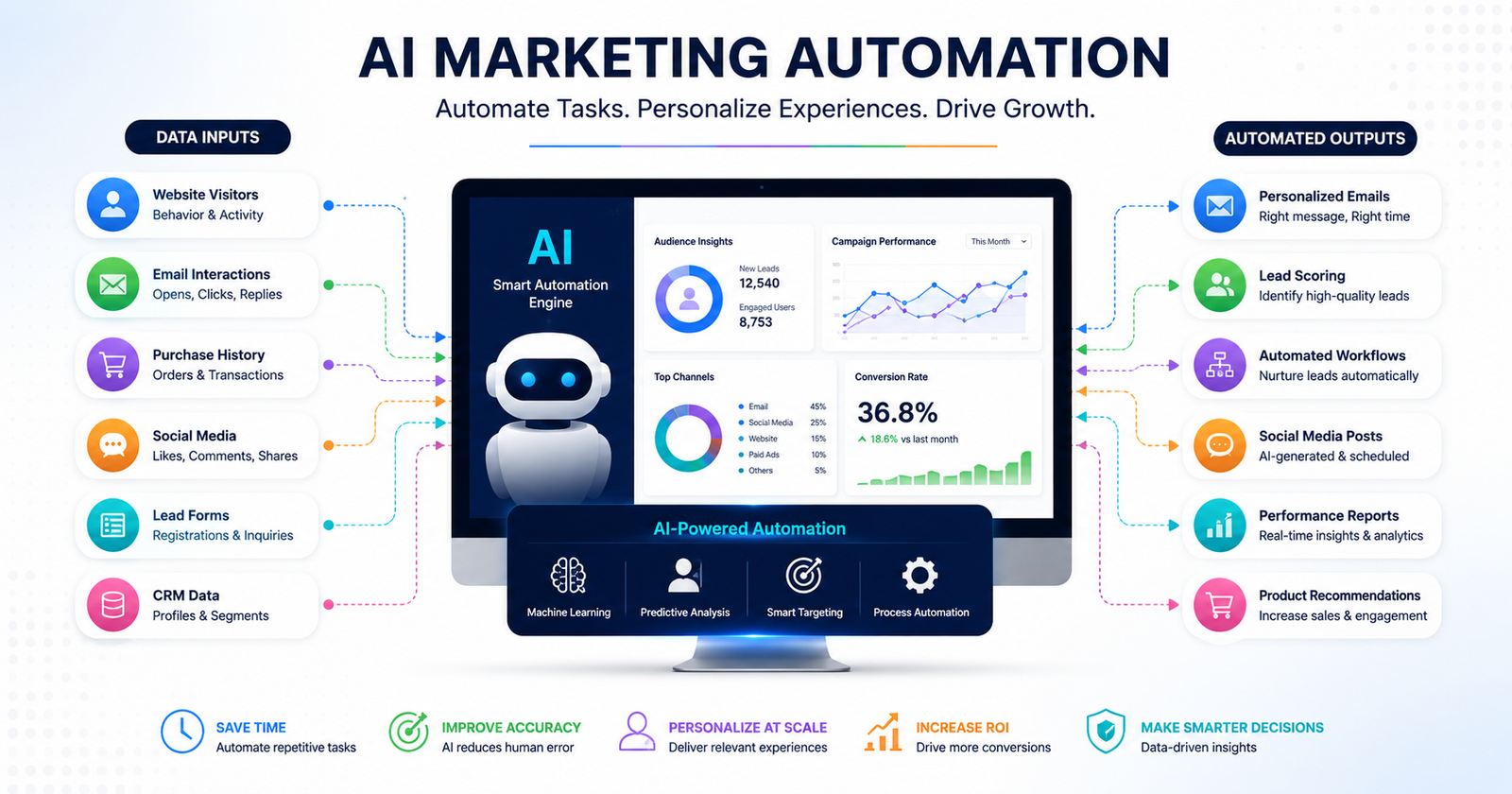
AI marketing automation tools collect data from websites, emails, social media platforms, customer relationship management systems, and online stores. The AI analyzes this information to understand customer behavior and preferences.
The system then uses these insights to automate marketing activities. It can create customer segments, predict future actions, recommend products, and personalize communication.
Many marketing automation tools also use machine learning. This means the software continues learning as it processes more data. The results become more accurate over time.
For example, if a customer frequently buys skincare products, the AI may automatically send product recommendations, special offers, or educational content related to skincare.
The biggest advantage is that marketers can focus on strategy while AI handles repetitive tasks. This creates better customer experiences and improves marketing performance.
Benefits of Using AI Marketing Automation Tools
Businesses of all sizes are adopting automation tools because of the many benefits they provide.
One major advantage is time savings. Tasks that once took hours can now be completed automatically. Email sequences, customer follow-ups, and campaign monitoring require less manual effort.
Another benefit is improved personalization. AI analyzes customer data and delivers content that matches individual interests. Personalized marketing often leads to higher engagement and better conversion rates.
Marketing automation tools also improve lead generation. They identify high-quality leads and prioritize prospects that are more likely to convert. Many platforms use predictive lead scoring to help sales teams focus on the right customers.
Businesses also benefit from better decision-making. AI provides detailed insights into campaign performance and customer behavior. Marketers can make data-driven decisions instead of relying on assumptions.
Finally, AI marketing automation tools help businesses scale their marketing efforts without significantly increasing costs.
Top AI Marketing Automation Tools in 2026
Many AI marketing automation tools are available today. Each platform offers different features and benefits.
| Tool | Best For | Key Features |
|---|---|---|
| HubSpot Marketing Hub | All-in-one marketing | CRM, email automation, AI content creation |
| ActiveCampaign | Small businesses | Email automation, segmentation, lead scoring |
| Klaviyo | eCommerce stores | Email, SMS marketing, predictive analytics |
| Mailchimp | Beginners | Email campaigns, AI recommendations |
| Customer.io | Customer journeys | Behavioral automation and messaging |
| Brevo | Budget-friendly marketing | Email, SMS, automation workflows |
| Zapier | Workflow automation | Connects thousands of apps |
| Jasper AI | Content marketing | AI writing and content generation |
These AI marketing automation tools are widely used by businesses worldwide because they combine automation, analytics, and personalization in one platform.
HubSpot as a Leading AI Marketing Automation Tool
Among all AI marketing automation tools, HubSpot is often considered one of the most complete solutions. It combines customer relationship management, email marketing, lead management, social media tools, and analytics in a single platform.
HubSpot uses AI to help marketers create content, score leads, automate workflows, and personalize customer experiences. Businesses can build complex customer journeys without needing technical skills.
One of the strongest features is predictive lead scoring. The AI analyzes customer behavior and identifies leads that are most likely to convert. This helps sales teams focus on the right opportunities.
HubSpot also includes reporting tools that provide detailed insights into campaign performance. Marketers can see what is working and make improvements quickly.
For businesses looking for an all-in-one solution, HubSpot remains one of the strongest AI marketing automation tools available today.
AI Marketing Automation Tools for eCommerce Businesses
eCommerce businesses face unique challenges. They need to manage large customer databases, recover abandoned carts, recommend products, and encourage repeat purchases.
AI marketing automation tools make these tasks easier. Platforms such as Klaviyo and Shopify Flow are designed specifically for online stores. They use customer data to create personalized shopping experiences.
For example, AI can automatically send cart recovery emails when customers leave products in their shopping carts. It can also recommend products based on previous purchases.
Predictive analytics is another valuable feature. AI can estimate customer lifetime value, predict future purchases, and identify customers who may stop buying.
This allows businesses to create targeted campaigns that increase revenue and improve customer loyalty.
For eCommerce brands, AI marketing automation tools are becoming essential for growth and customer retention.
AI Marketing Automation Tools for Content Marketing
Content marketing requires a lot of time and effort. Businesses need blog posts, social media updates, email newsletters, and marketing copy on a regular basis.
AI marketing automation tools help simplify content creation. Platforms like Jasper AI and AI-powered features within marketing platforms can generate content ideas, write drafts, and improve existing content.
AI can also analyze content performance and suggest improvements. This helps marketers create content that attracts more traffic and engagement.
Another advantage is consistency. AI marketing automation tools make it easier to maintain a regular publishing schedule across multiple channels.
Businesses can produce more content without increasing workload. This helps improve brand visibility and strengthen relationships with customers.
While human creativity remains important, AI tools can significantly speed up content production and optimization.
How to Choose the Right AI Marketing Automation Tools
Choosing the best AI marketing automation tools depends on your business goals, budget, and marketing needs.
Small businesses often prefer simple and affordable solutions. Platforms like Mailchimp, Brevo, and ActiveCampaign provide strong automation features without high costs.
Larger organizations may need advanced capabilities such as CRM integration, predictive analytics, and multi-channel campaign management. HubSpot and Salesforce Marketing Cloud are common choices for these businesses.
Before selecting a platform, consider factors such as ease of use, integration options, scalability, customer support, and reporting features.
You should also evaluate AI capabilities. Some tools offer basic AI functions, while others provide advanced predictive analytics and autonomous optimization.
Testing free trials can help businesses compare different AI marketing automation tools before making a final decision.
Future of AI Marketing Automation Tools
The future of AI marketing automation tools looks very promising. AI technology continues to improve every year, making automation smarter and more effective.
Future platforms will likely provide deeper personalization, stronger predictive capabilities, and more autonomous decision-making. AI agents may manage entire marketing campaigns with minimal human involvement.
Businesses are already using AI to create content, optimize advertising campaigns, and improve customer experiences. As technology advances, these capabilities will become even more powerful.
Voice assistants, conversational AI, predictive customer journeys, and real-time optimization are expected to become standard features.
Companies that adopt AI marketing automation tools early will be better positioned to compete in an increasingly digital marketplace.
The businesses that combine human creativity with AI efficiency are likely to achieve the best results in the coming years.
Comparison of Popular AI Marketing Automation Tools
| Feature | HubSpot | ActiveCampaign | Klaviyo | Mailchimp |
|---|---|---|---|---|
| Email Automation | Yes | Yes | Yes | Yes |
| CRM Integration | Yes | Yes | Limited | Limited |
| AI Lead Scoring | Yes | Yes | No | Basic |
| Predictive Analytics | Yes | Yes | Yes | Basic |
| eCommerce Support | Good | Good | Excellent | Good |
| Content Generation | Yes | Limited | Limited | Basic |
| Best For | All Businesses | SMBs | eCommerce | Beginners |
This comparison helps businesses understand which AI marketing automation tools fit their needs best.
Conclusion
AI marketing automation tools have transformed the way businesses market their products and services. They automate repetitive tasks, improve personalization, enhance customer engagement, and provide valuable insights.
Whether you run a small business, a growing eCommerce store, or a large enterprise, the right AI marketing automation tools can help you save time and increase results. Platforms like HubSpot, ActiveCampaign, Klaviyo, Mailchimp, and Customer.io offer powerful features for modern marketers.
As AI technology continues to evolve, these tools will become even smarter and more effective. Businesses that embrace AI marketing automation today can gain a strong advantage in the future.
Frequently Asked Questions
What are AI marketing automation tools?
AI marketing automation tools are software platforms that use artificial intelligence to automate marketing tasks such as email campaigns, lead scoring, customer segmentation, and content personalization.
Which AI marketing automation tool is best for small businesses?
ActiveCampaign, Mailchimp, and Brevo are popular choices for small businesses because they offer affordable pricing and easy-to-use automation features.
Can AI marketing automation tools improve sales?
Yes. AI marketing automation tools help businesses identify high-quality leads, personalize customer communication, and optimize campaigns, which can increase conversions and sales.
Are AI marketing automation tools suitable for eCommerce stores?
Yes. Tools like Klaviyo and Shopify Flow are designed specifically for eCommerce businesses and offer features such as cart recovery, product recommendations, and predictive analytics.
Do AI marketing automation tools replace marketers?
No. AI marketing automation tools assist marketers by automating repetitive tasks and providing insights. Human creativity, strategy, and decision-making remain important for successful marketing.