What Is AI Automation?
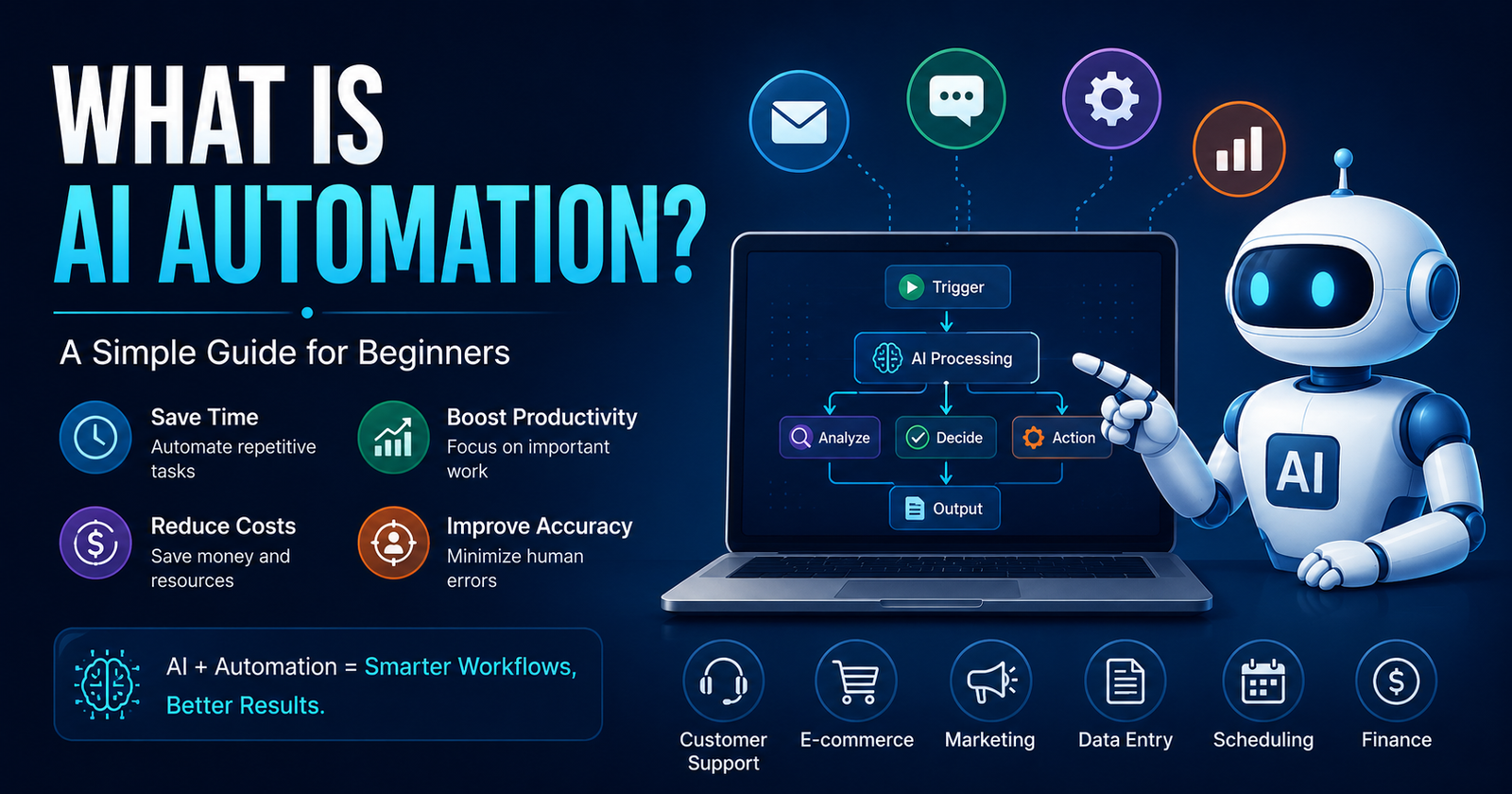
AI automation is the process of using artificial intelligence to complete tasks automatically with little or no human effort. It combines traditional automation with AI technologies such as machine learning, natural language processing, and data analysis. The goal is to reduce manual work and improve speed, accuracy, and productivity.
In the past, automation could only follow fixed rules. It worked well for simple and repetitive tasks. AI automation goes further because it can learn from data, understand information, and make decisions based on patterns. This makes it useful for more complex tasks.
Today, businesses use AI automation in customer service, marketing, sales, healthcare, finance, and many other industries. AI tools can answer customer questions, schedule meetings, create reports, analyze data, and even generate content.
As AI technology continues to improve, AI automation is becoming one of the most important tools for businesses that want to grow faster and work more efficiently.
How AI Automation Works
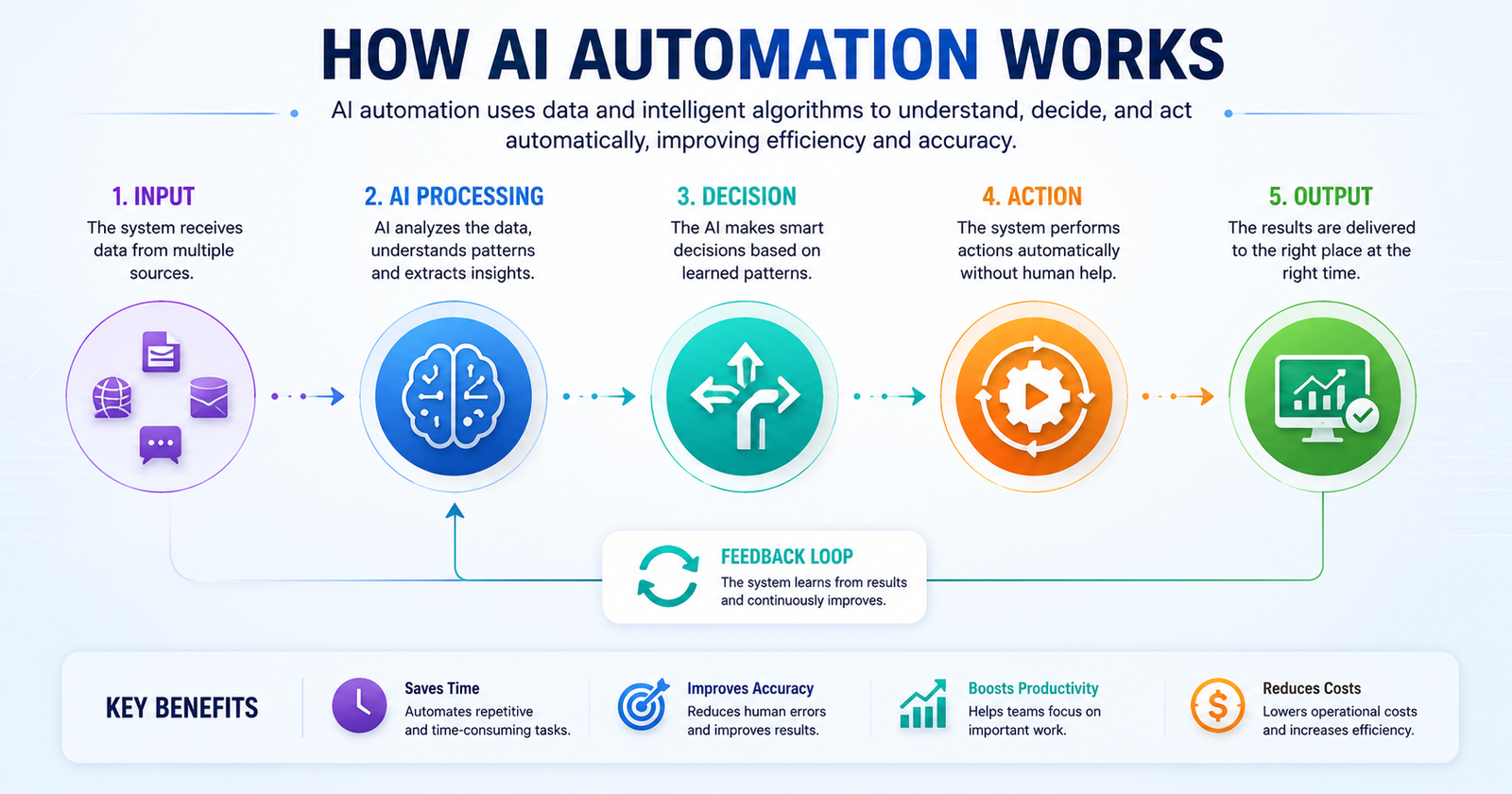
AI automation works by combining data, software, and artificial intelligence models. The system receives information, processes it, and then performs actions automatically. Instead of waiting for a person to complete each step, the AI system handles the workflow.
For example, when a customer sends an email, AI automation can read the message, understand the request, classify it, and send a suitable response. If needed, it can also forward the request to the correct department.
Modern AI automation systems often use machine learning models that improve over time. They learn from previous actions and become more accurate as they process more data.
Many companies also connect AI automation with tools like customer relationship management software, email platforms, databases, and project management systems. This allows information to move between different applications automatically.
Because of this ability to learn and adapt, AI automation can handle tasks that traditional automation cannot manage effectively.
Difference Between Traditional Automation and AI Automation
Many people think automation and AI automation are the same thing. They are related, but there are important differences.
| Traditional Automation | AI Automation |
|---|---|
| Follows fixed rules | Learns from data |
| Handles simple tasks | Handles complex tasks |
| Needs manual updates | Can adapt over time |
| Works with structured data | Works with structured and unstructured data |
| Limited decision-making | Intelligent decision-making |
Traditional automation is useful for repetitive activities such as moving files or sending scheduled emails. AI automation can understand language, analyze documents, recognize images, and make recommendations.
For example, a traditional chatbot follows pre-written responses. An AI-powered chatbot can understand customer intent and provide more natural answers.
This ability to adapt and learn makes AI automation much more powerful for modern businesses.
Why AI Automation Is Important
AI automation helps businesses save time and reduce costs. Employees spend less time on repetitive work and can focus on tasks that require creativity and strategic thinking.
Many organizations receive large amounts of information every day. Processing this information manually takes time and often leads to mistakes. AI automation can analyze huge amounts of data within seconds and provide accurate results.
Customer expectations are also increasing. People want quick responses and fast service. AI automation allows companies to respond instantly through chatbots, automated emails, and intelligent support systems.
Another major benefit is scalability. A business can handle more customers without hiring a large number of employees. This improves efficiency while controlling costs.
Companies that adopt AI automation often improve productivity, customer satisfaction, and business growth. This is why AI automation has become a major part of digital transformation strategies across industries.
Common Examples of AI Automation
You probably use AI automation every day without realizing it. Many popular digital services rely on AI to perform tasks automatically.
Email platforms use AI automation to filter spam messages. Streaming services recommend movies based on your viewing history. Online stores suggest products based on previous purchases.
Businesses use AI automation in many ways:
| AI Automation Example | Purpose |
| AI chatbots | Customer support |
| Email automation | Marketing campaigns |
| Lead qualification | Sales process |
| Invoice processing | Finance operations |
| Appointment scheduling | Business management |
| Content generation | Marketing and blogging |
| Data entry automation | Administrative tasks |
These examples show how AI automation reduces manual work and improves efficiency. Businesses can complete tasks faster while maintaining consistent quality.
AI Automation in Business
Businesses are among the biggest users of AI automation. Companies use it to automate daily operations, improve customer experiences, and increase revenue.
In customer support, AI chatbots answer common questions instantly. This reduces waiting times and helps support teams focus on more complex issues.
In marketing, AI automation creates personalized email campaigns and customer journeys. It can track user behavior and send targeted messages automatically.
Sales teams use AI automation to qualify leads, update customer records, and schedule follow-ups. This allows sales representatives to spend more time closing deals.
Human resources departments use AI automation for resume screening, employee onboarding, and document management.
Finance teams automate invoice processing, expense tracking, and financial reporting. These workflows reduce human errors and improve accuracy.
As a result, businesses can operate more efficiently while delivering better services to customers.
Benefits of AI Automation
The popularity of AI automation continues to grow because it offers many practical benefits.
One major advantage is time savings. Tasks that once took hours can now be completed within minutes or seconds. This increases productivity across departments.
AI automation also reduces mistakes. Human workers can make errors when handling repetitive tasks. Automated systems follow processes consistently and accurately.
Another benefit is cost reduction. Businesses can automate routine work instead of hiring additional staff for repetitive tasks.
AI automation improves customer experiences as well. Customers receive faster responses and better support.
The technology also provides valuable insights by analyzing large amounts of data. Businesses can identify trends, understand customer behavior, and make smarter decisions.
These advantages make AI automation a valuable investment for organizations of all sizes.
Popular AI Automation Tools
Many tools help businesses build AI automation workflows. Some tools are designed for beginners, while others support advanced automation projects.
| Tool | Main Use |
| Zapier | App automation |
| Make | Workflow building |
| n8n | Custom automation |
| ChatGPT | Content and assistance |
| Microsoft Power Automate | Business automation |
| UiPath | Enterprise automation |
These tools allow users to connect applications, automate tasks, and create intelligent workflows without extensive programming knowledge.
Many businesses start with simple workflows and gradually expand their AI automation systems as they gain experience.
Challenges of AI Automation
Although AI automation offers many benefits, it also comes with challenges.
Data quality is one of the biggest issues. If the data is inaccurate or incomplete, the AI system may produce poor results. Businesses must maintain clean and reliable data.
Integration can also be difficult. Companies often use many different software systems. Connecting everything correctly requires planning and technical expertise.
Security and privacy are important concerns as well. Organizations must protect sensitive information when using AI tools.
Some businesses also expect immediate results. Successful AI automation usually starts with small projects before expanding into larger workflows.
Despite these challenges, companies that implement AI automation carefully often achieve significant improvements in efficiency and performance.
The Future of AI Automation
The future of AI automation looks very promising. New AI models are becoming smarter, faster, and more capable every year.
Businesses are moving beyond simple automation and adopting intelligent systems that can make decisions, solve problems, and complete entire workflows. These systems are often called AI agents or agentic AI.
Future AI automation platforms will manage customer service, business operations, marketing campaigns, and data analysis with minimal human involvement.
Experts believe that AI automation will become a standard part of business operations across nearly every industry. Companies that adopt it early may gain a competitive advantage through higher productivity and lower operating costs.
As technology continues to improve, AI automation will help people work more efficiently rather than replacing human creativity and expertise.
Conclusion
AI automation is changing the way businesses and individuals work. It combines artificial intelligence with automation to complete tasks faster, more accurately, and with less manual effort.
From customer support and marketing to finance and human resources, AI automation helps organizations save time, reduce costs, and improve productivity. It can handle repetitive tasks, analyze information, and make intelligent decisions based on data.
As AI technology continues to evolve, AI automation will become even more powerful and accessible. Businesses that learn how to use AI automation today will be better prepared for the future of work.
FAQs
What is AI automation in simple words?
AI automation is the use of artificial intelligence to perform tasks automatically without constant human involvement.
How is AI automation different from regular automation?
Regular automation follows fixed rules, while AI automation can learn from data and adapt to different situations.
Can small businesses use AI automation?
Yes. Many affordable AI automation tools help small businesses automate marketing, customer support, scheduling, and other daily tasks.
What are examples of AI automation?
Examples include AI chatbots, automated email marketing, content generation, invoice processing, and lead qualification systems.
Is AI automation a good career?
Yes. AI automation is a growing field with increasing demand as more businesses adopt automation technologies and AI-powered workflows.